
Online casino PayID withdrawal: what the cashier means by it, and what actually happens
PayID deposits work from Australia and are one of the most common ways money goes into an offshore casino account: you open your own banking app, send a payment to the PayID the cashier displays, and the balance usually appears within a minute. That direction is simple because you are the payer. An online casino PayID withdrawal is the same word pointed the other way, and it is not the same transaction.
The conditions on the deposit leg are bank-side, not casino-side. Your PayID must already be registered with your own Australian bank — it is a mobile number, email address or ABN that you attach to one of your accounts from inside internet banking — and the payment goes in Australian dollars from an account in your own name. Your bank's daily transfer limit applies, not the casino's, and some banks decline or flag payments they identify as gambling-related, which is a refusal you resolve with the bank rather than with support. Credit cards are not a route here at all; this is an account-to-account transfer. The cashier's own minimum sits on top of all that, and the higher of the two numbers is the one you have to meet.
 Best casinos available in AustraliaUpdated 7 November 2026

WinCrown · Welcome bonus200 free spins on selected slots
Reviews (9,827)
4.9Rating

The site's legal publisher and named human editor remain a pre-indexation disclosure requirement. No fictional person is attributed to this article.
What an online casino PayID withdrawal actually describes
PayID is an addressing service. It was built so that a payer can send money without typing a BSB and account number, and so the payer sees the registered account name before confirming. That is its whole job: it labels a destination. It does not give anyone the ability to reach into an account and take money out.
Which means the two directions are structurally different. On the way in, you are the payer: you initiate the transfer from your bank, the casino's PayID is the destination, and nothing needs to happen on the operator's side except noticing the credit. On the way out, the operator is the payer. It has to initiate a payment to your PayID, from an account it controls, through a bank that can reach the network PayID runs on.
That last condition is the one the marketing skips. The network is the New Payments Platform, the Australian rail that moves account-to-account payments in near real time, every day of the year — the same rail behind Osko transfers your bank shows as arriving in seconds. To send a payment addressed to a PayID, the sender needs an Australian account with access to that platform. Offshore casino companies generally do not hold one.
So "PayID withdrawal" in a cashier is a label on a payout route, and the route underneath it varies. Sometimes it is a genuine PayID credit sent by an Australian payment partner. More often it is an ordinary bank transfer to the account sitting behind your PayID, badged with the name of the method you used to deposit. Both can be legitimate. They behave differently, and the difference is entirely about time.
How PayID works in the direction that matters
Three mechanics decide everything on this page, and they are worth stating plainly because almost no casino page does.
- A PayID points to one account, and you control the pointer. You register it in your own internet banking, and you can move it to a different account or a different bank later. The operator never sees anything except the identifier and the account name your bank publishes against it.
- Payments are pushed, never pulled. There is no mandate, no direct debit, no stored authority. Each transfer is initiated by whoever holds the money at that moment. On a withdrawal, that is the operator.
- The name check runs on the payer's screen. Whoever sends a payment to your PayID sees the account name registered against it before confirming. This is the feature that prevents misdirected money, and it is also where mismatched names surface.
The third point has a consequence people only discover at the worst moment. If the name on your bank account is not the name on your casino account, a payout to your PayID is a payment to a different person as far as compliance is concerned. Joint accounts are the common trap: a PayID registered to a joint account can display both names, or a combined form of them, and that is not a match for a single-name casino registration.
The second point explains why there is no such thing as the casino "taking" money from your account, and also why a withdrawal cannot be faster than the operator's decision to send it. Nothing about the network's speed helps while a request sits in an approval queue.
Why a payout labelled PayID often arrives as a bank transfer
Here is the honest centre of this topic. An operator can accept your PayID deposit easily, because your bank did the work. Paying you back the same way requires it to be an Australian payer, and the usual arrangement is an intermediary: a local payment provider that holds an Australian account and sends on the operator's instruction.
Depending on what that provider can do, you get one of three outcomes.
- A true PayID credit. The provider addresses the payment to your PayID over the fast rail. Once sent, it lands in seconds and shows in your app with the sender's description. This is what the label promises.
- A bank transfer to the account behind your PayID. The provider sends to your BSB and account number instead of the identifier. Same destination, different addressing, and it may travel as a standard transfer with normal banking timeframes rather than instantly.
- An international transfer. No Australian intermediary is involved, so the funds arrive from abroad, possibly in a different currency with a conversion applied by somebody along the way, and on the slowest timetable of the three.
You can usually tell which one you are getting from the withdrawal form itself, before you submit anything. If the form asks only for your PayID, it is addressing the fast rail. If it asks for account name, BSB and account number, it is a bank transfer whatever the tab is called. If it asks for a SWIFT or BIC code, an IBAN, or your full residential address for the bank, it is an international payment and the PayID label is decoration.
None of this makes an operator dishonest. It does mean the phrase in the method list is not a commitment about speed, and that two operators both offering "PayID withdrawal" can be days apart in practice. Treat the form as the specification and the label as advertising.
Four stages, four different controllers
Every payout passes through the same four stages. Conflating them is why "instant withdrawal" claims survive: they describe stage three and ignore stage one, which is the long one.
| Stage | Who controls it | What can hold it up | What you can do about it |
|---|---|---|---|
| Request accepted and reviewed | The operator's finance and compliance team | Verification not complete, open bonus funds, unusual pattern, manual review thresholds, weekend and public-holiday staffing | Complete verification in advance; clear or forfeit bonus balances before requesting; submit on a weekday |
| Payment instruction issued to the provider | The operator | Batch processing windows, provider float, payout caps per transaction or per day | Request an amount under the stated per-transaction cap so it is not split |
| Funds move across the banking network | The payment provider and the network | Which route was used — fast rail in seconds, standard transfer in business days, international slower still | Choose the method whose form asks only for the PayID, if that choice exists |
| Your bank credits the account | Your bank | Incoming-payment screening, first-time-sender checks, holds on inbound international funds | Use an account you have held for a while; expect a one-off check on a first inbound payment from a new sender |
Read it top to bottom and the pattern is obvious: the stages you can influence are the first and the last, and both are about paperwork rather than payment technology. Stage one is where days are lost. Stage three, the only one PayID actually speeds up, is measured in seconds when it applies at all.
This is also the answer to a question we get asked in a different form on the page about winning real money: the payout chain, not the game, decides whether a balance becomes money you can spend.
What verification asks for, and when it bites
Identity checks are not optional and not negotiable, and the single most useful thing you can do about withdrawal speed is to finish them before you need a withdrawal. Most operators let you upload documents the day you register. Almost nobody does, and then the request sits in stage one while the account is verified from scratch.
For a bank-account payout, expect three categories of document.
- Identity. A government photo document, usually a passport or driver licence, with all four corners visible and the details legible. Photographs of a screen tend to be rejected.
- Address. A recent utility bill, bank statement or government letter showing your name and residential address. The name has to match the casino account exactly, including middle names if you registered with one.
- Ownership of the payment destination. This is the one specific to bank payouts: a statement or banking-app screenshot showing your name together with the account, and — where the operator asks for it — the PayID registered against it. A screenshot that shows the PayID but not the account holder name usually gets sent back.
Above larger amounts, a source-of-funds request can be added: evidence of where the money you deposited came from. That is a standard anti-money-laundering step rather than an accusation, but it takes time and it is triggered by amount, so it tends to appear on exactly the withdrawal you most want processed quickly.
One timing detail worth knowing. If you moved your PayID to a different account or a different bank after depositing, the ownership proof you upload will not line up with the deposit record, and the review goes manual. Moving a PayID is a two-minute job in a banking app and a week-long problem in a compliance queue. Leave it where it was until the money is back. Our wider approach to checks like these is written up in how we review.
The same-method rule, and why an online casino PayID withdrawal is the awkward case
Most operators return funds the way they arrived. The rule exists for anti-money-laundering reasons: a closed loop means money leaves by the route it entered, which makes layering harder. For bank transfers it is easy to satisfy. For everything else it gets complicated, and the complications are where delays come from.
| You deposited by | Is a bank or PayID payout available | What the operator usually requires |
|---|---|---|
| PayID from your own bank account | Yes — this is the clean case | Proof that the account and PayID belong to you; the destination is already the recorded source |
| Standard bank transfer | Yes | Same proof; the destination is the sending account, so a different account needs explaining |
| Debit card | Often partially | A return to the card up to the deposited amount first, with the remainder by bank transfer; card statement may be requested |
| Voucher or prepaid method | Yes, because there is no return path on the voucher | Full verification plus bank-ownership proof, since the payout route is not the deposit route by necessity |
| Cryptocurrency | Usually not, or only by exception | Many operators pay back only to the originating wallet; a bank payout here is a policy exception and often refused |
The row that surprises people is the voucher one. A prepaid method is a one-way street by design — there is nothing to send money back to — so the operator has to nominate an alternative destination, and the same-method rule cannot be satisfied. Far from making things easier, that means heavier checks, because the loop is open and the compliance team has to establish the destination from documents instead of from the transaction record. If you are thinking about small or promotional balances, that interacts badly with the thresholds we go through in what no-deposit offers change.
The practical takeaway is short: if you intend to take money out to your bank account, put money in from that same bank account. A PayID deposit followed by a bank-side payout is the only combination where the source and the destination are the same record, and it is the combination that argues least with the rules.
The numbers to find before you request anything
Five figures govern whether a withdrawal works, and all five are published before you need them — in the cashier and in the terms, not in the method list. Finding them takes a few minutes and saves the week you would otherwise spend asking support why nothing has moved.
- Minimum withdrawal. If it sits above your balance, the balance cannot leave at all, and that is a far more common dead end than any processing delay. It is frequently higher than the minimum deposit.
- Maximum per transaction. A request above this is either refused or split into instalments, and each instalment re-enters stage one separately.
- Maximum per day, week or month. This is the figure that decides what happens to a large win. Monthly caps turn a single amount into a schedule.
- Stated processing window. The time the operator says it needs before the payment leaves. This is the only timing promise an operator can actually make, because the later stages are not its to control.
- Fees on the operator's side. PayID itself is normally free at Australian banks for personal accounts, but an operator or its provider can charge its own withdrawal fee, and an international leg can carry a currency conversion. Read the fee line in the cashier for the method you are using, not a general banking page.
Pair those five with your own bank's inbound behaviour and you have the full picture. Note that the one limit everybody checks — your bank's daily transfer limit — governs deposits only. It is irrelevant on the way back, because you are not the payer. The same split between the site's number and the method's number runs through every amount in a cashier, which we worked through for deposits in what a fifteen-dollar minimum really means.
What a request looks like hour by hour
The table below is an illustrative sequence, not a promise from any operator, and the durations are placeholders to show where time goes rather than measured figures. Replace them with the processing window your own cashier publishes.
| Point in the sequence | Fast rail, account fully verified | Bank transfer, verification outstanding |
|---|---|---|
| You submit the request | Hour 0 | Hour 0 |
| Operator review | Within the published processing window | Paused — documents requested |
| You supply documents | Already done at sign-up | Hour 0 plus a day or two, your side |
| Review resumes and completes | Same business day in this example | After documents are accepted |
| Payment instruction issued | Immediately after approval | Next batch after approval |
| Funds cross the network | Seconds | Standard transfer timeframes |
| Visible in your app | Same day in this example | Several days later in this example |
Both columns describe the same amount from the same operator. The entire difference is paperwork completed in advance and which route the form addressed. Neither column contains a stage where PayID itself was slow, and neither contains a trick — that is simply where the hours sit.
There is one honest caveat on the fast-rail column. Once a payment is sent over that network it is not easily reversed, which is exactly why the payer sees the account name first. That protection is on the sending screen, and on a withdrawal the sending screen is the operator's, not yours. Your protection is having given it the right identifier and the right name.

What goes wrong, and which failures you can fix
Six failures account for most of the complaints about this method, and five of them are fixable before they happen.
- Name mismatch. The casino account says one name, the bank account another — a maiden name, a shortened first name, a joint account showing two. Fix it on the casino side before requesting, since that side is editable and the bank's is not.
- PayID not registered, or registered elsewhere. Entering an identifier you have not actually attached to an account in internet banking produces a payment that cannot be delivered. Check it in your banking app first.
- PayID moved after the deposit. The ownership proof no longer matches the transaction record and the review goes manual.
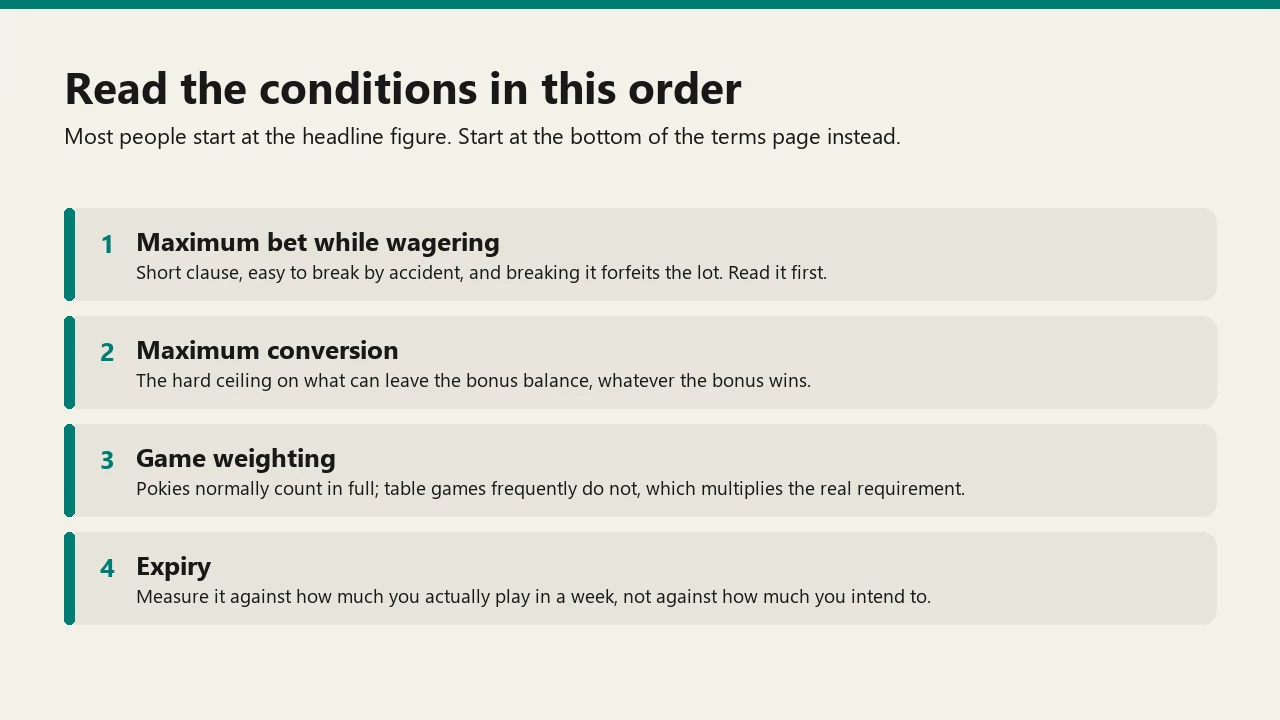
- An open bonus balance. Many operators will not process a withdrawal while wagering is incomplete, and submitting one can forfeit the bonus. Resolve the bonus deliberately rather than by accident.
- A request above the per-transaction cap. It gets split, and each part queues separately, so one amount becomes several waits.
- Your own bank screening an inbound payment. Less common and not your fault, but a first payment from an unfamiliar sender can be held briefly for checks. Nothing to do but wait; the money is not lost.
What is not fixable is the legal frame. Online casino games cannot be lawfully offered to people in Australia under the Interactive Gambling Act, which the ACMA enforces, so every operator in this category is based elsewhere. That is the background to all of the above: no Australian authority supervises the payout, your escalation route runs to a foreign licensing body, and site access can be interrupted. We set out which options are domestically licensed in legal gambling options, and the rules that apply to pokies in this state specifically in the WA pokies law page.
Before your first withdrawal request
Everything above condenses into eight things done in advance, in this order. None of them takes long, and together they remove the stages where withdrawals actually stall.
- Register your PayID in your own internet banking and confirm it points to the account you want the money in.
- Check the account name your bank publishes against that PayID, exactly as a payer would see it.
- Register the casino account in that same name, in full, with no shortenings.
- Upload identity, address and account-ownership documents on day one, before any deposit.
- Deposit from that same bank account, so the source and the destination are one record.
- Write down the five cashier figures — minimum, per-transaction cap, periodic cap, processing window, fee — on the day you open the account.
- Resolve any bonus balance intentionally before requesting, knowing whether it will be forfeited.
- Request an amount under the per-transaction cap, on a weekday, and read the form to see whether it is asking for a PayID or for a BSB and account number.
Do those eight and the PayID label finally means what you expected it to mean: money arriving in seconds, because everything that could have made it take days was dealt with weeks earlier. For over-18s only, and withdraw amounts you were prepared to lose in the first place.
PayID withdrawal questions from WA readers
Can an online casino send money straight to my PayID?
Only if the party paying you has an Australian bank account with access to the fast payments network. Where an operator uses a local payment provider, a genuine PayID credit is possible and lands in seconds. Where it does not, the payout travels as an ordinary bank transfer to the account behind your PayID, or as an international transfer, regardless of what the cashier tab is called.
How do I tell which route I am actually getting?
Read the withdrawal form before submitting. A form that asks only for your PayID is addressing the fast rail. One that asks for account name, BSB and account number is a bank transfer. One that asks for SWIFT, BIC or IBAN details is an international payment, and the PayID label on the tab is cosmetic.
Why is my withdrawal still pending when PayID is supposed to be instant?
Because the instant part is one of four stages, and it is the last one before your bank. The time is almost always spent in the operator's review queue — incomplete verification, an open bonus balance, a manual-review threshold or weekend staffing. The network leg takes seconds once a payment is actually sent.
Do I have to withdraw to the same account I deposited from?
In practice, yes, and it is to your advantage. Operators return funds to the recorded source for anti-money-laundering reasons, so a PayID deposit from your own account makes the return leg the simplest possible case. Nominating a different account, or depositing by a method that cannot receive money back, both push the request into manual review.
What does the casino need to prove the PayID is mine?
Typically a bank statement or banking-app screenshot that shows your name together with the account, and often the PayID registered against it. A screenshot showing the identifier alone is usually rejected because it does not establish the account holder. Supply it before your first withdrawal rather than after.
Does a PayID withdrawal cost anything?
PayID itself is normally free at Australian banks for personal accounts, so any charge comes from the operator or its payment provider, and an international leg can also carry a currency conversion. The figure that matters is the fee line beside that specific method in the cashier, not a general banking page.